What Are the Similarities Tghe Women in Art Had in Common
Artistic Representation of the Female person Gender from the Renaissance to the Enlightenment
Katryna Santa Cruz

Tintoretto, Susanna and the Elders, 1555-6; Wikipedia
Introduction
Art is a product of its fourth dimension. It is a result of the social, political, and religious context in which it was fabricated. Considering of its consequential nature, it has become the centre of focus for historians interested in revisionist theories about the representation of its subjects. This inquiry guide has compiled sources of data that lend itself to a research paper on the representation of women in art history. The sources in this research guide form connections between art and history to provide arguments for or against the thought of a factual representation of women in fine art.
The guide consists of a Full general Overview section with sources that cover a broad sense of the representation of women in art in several fine art periods but focusing on Victorian Art, Renaissance Art, and Fine art of the Enlightenment. Other sections in this research guide include Representation of Rape in Art History, Women in Religious Fine art and Imagery, Gender Neutrality in Art, Gender Differences in Art, and Sexuality and Eroticism in Art.

Manet, Olympia, 1865; Wikipedia
General Overview
- FEMINISM AND Art HISTORY: QUESTIONING THE LITANY
In Feminism and Fine art History: Questioning the Litany , authors Norma Broude and Mary Garrard identify fine art production in social context. Through several essays, the authors show how the social, political, and religious circumstances of different fine art periods bear on the fashion women were represented. Feminism and Art History includes a broad range of art periods including Egyptian Pharaoh Fine art, Roman Art, Medieval Art, 18th and 20th-century fine art and concludes with American quilts. The authors spread the content of the essays amid different regions in Europe which I feel is essential to a study on the representation of women in art as it lends itself every bit an enciclopediac-like source for all of Europe, rather than just one state or region.
I feel this source is critical in doing research on the representation of women in art as it offers diversity in content relative to the thesis, extensive evidence to back up its arguments, and a generally unbiased presentation of information every bit it seeks to create a new fine art history rather than simply working with the modernistic version.
Broude, North. & D Garrard, One thousand. Feminism and Fine art History: Questioning the Litany. New York: Harper & Row, 1982.
- THE EXPANDING DISCOURSE: FEMINISM AND ART HISTORY
The sequel to Feminism and Fine art History: Questioning the Litany , The Expanding Discourse: Feminism and Fine art History presents an even more than influential source of information every bit it aims to expand the knowledge delivered in Feminism and Art History to art outside of Western culture. Written in the aforementioned style, a compilation of essays, The Expanding Discourse begins in Early Renaissance culture and paves a new path of art history through the critiques of works by Botticelli, Rubens, Degas, Gauguin, Kahlo, O'Keeffe, and many other iconic artists.
Although this sequel is heavily shaped by feminist theories, creating a somewhat biased presentation of data, I believe the authors were more effective in setting the sociopolitical context. Without inserting gender theories, ones relevant to the time when the art was created, their thesis would have become out of context and their arguments would have lessened in relevance and influence. Although the majority of this book focuses on postal service-Renaissance art, I feel it is important in conducting research on the representation of women in art equally information technology touches upon subjects that were not discussed in the prequel including sexual violence, lesbianism, and early feminism (all during or before the Renaissance).
Bourde, N. & D Garrard, Yard. The Expanding Soapbox: Feminism and Fine art History . Bedrock, CO: Westview Press, 1992.
- WOMEN IN RENAISSANCE Art: GENDER, REPRESENTATION, IDENTITY
Paola Tinagli gives a full general overview of women as subject field-matter in Italian Renaissance painting. I believe this is an essential source of information as the author places a heavy focus on 1 of the cardinal concepts in studying art history; the relationship betwixt the patron and the artist. Nearly subject-matter in Renaissance Art is a direct product of this relationship and no art history critique is complete without consideration of it. The writer's evidence for these relationships are found in messages, poems, and treatises that she revises herself, rather than the use of the already established art historical stories.
- THE Female person NUDE: ART, OBSCENITY, AND SEXUALITY
Lynda Nead's The Female person Nude: Art, Obscenity, and Sexuality seeks to detectwhy the female nude has become an icon of Western culture. The prevalence of images of the female body in the history of Western art has begun to tie the female person nude to an 'art' connotation, even in modern fine art. Nead discusses the dissemination of the 'high art' female nude in art education and supports her argument by using art publications and the language of art criticism itself to bring together an entirely new analysis of the historical tradition of female person nudes in art. Although The Female Nude attempts to discover the reason for the trend, I felt this source tin provide prove of early nudes in art pertinent to the age periods for which this research guide is catered to.
Nead, L. The Female person Nude: Art, Obscenity, and Sexuality . London: Routledge, 1992.
- WOMEN FROM THE RENAISSANCE TO THE ENLIGHTENMENT
In this short essay, Saylor Academy offers a meaty wait at the effects of 15th-18th century European lodge on the representation of women in art. They offer concise summaries regarding women's status in society, Dual Representations of Women During the Renaissance, Effects of the Protestant and Catholic Reformation on Women, and Women and the Enlightenment.
As the author explores, women didn't have a voice in their communities regarding economics or politics. Their most of import job was to be a mother and married woman, before being a woman. As the Enlightenment pervaded the European society, "women began to take reward of new intellectual trends." The author so discusses dual representations of women during the Renaissance — a complex adult by Sigmund Freud chosen "the Madonna-Whore complex" where men see women as either Madonnas or whores. As the writer explains, figures of the Renaissance represented women as they were in seen in their times — "as either virtuous and celibate or seductive and deceptive." Effects of the Protestant and Cosmic Reformation on Women explores the thought of the patriarchy (and in plough, the Church, the nearly powerful political force of the time) controlling women in a style that led to their discrimination and persecution throughout Europe and North America (using the Salem Witch Trials as an case). Women and the Enlightenment explores women and their interest in salon culture and literature. Although this essay doesn't provide any specific artistic examples of the representation it discusses, it does provide social, political, and religious reasons for why Renaissance fine art represents women the way information technology does.
"Women From the Renaissance to the Enlightenment." Saylor Academy. Jan one, 2014. Accessed Nov 13, 2014. http://world wide web.saylor.org/site/wp-content/uploads/2012/10/HIST201-8.2.three-WomenRenaissancetoEnlightenment-FINAL1.pdf.
- WOMEN As Subject field IN VICTORIAN ART — REPRESENTATIONS OF WOMEN
This source, although in an informal format, provides numerous links that represent the near common trends in Victorian Art (late 19th century). These categories include Female Power (e.g. goddesses, femme fatale, monster women, etc.), Female Powerlessness – Woman as Victim (due east.g. women in chains, martyrs, fallen women, etc.), Objects of Want (e.thou. the adoring woman), Women as Ideal (e.chiliad. madonnas and mothers), and Miscellaneous (due east.one thousand. servants and governesses).
I find this source to exist a healthy complementary to the previous source ( Women From the Renaissance to the Enlightenment ) every bit it offers a visual representation of the reasons that Women From the Renaissance to the Enlightenment delivered for the representation of women in art, although this source focuses on a afterward art catamenia. Some of the links in this source lead to essays digressing into each of the topics while other links provide a wide array of paintings, symbols, and illustrations that autumn under each category (Female person Power, Woman as Victim, etc.).
"Women every bit Field of study in Victorian Fine art — Representations of Women." Victorian Web. July thirteen, 2009. Accessed November thirteen, 2014.http://www.victorianweb.org/gender/arts2.html
Representation of Rape in Art History
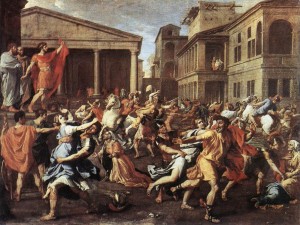
Poussin, Rape of the Sabine Women, 1637; Wikipedia
- FROM VICTIM TO VICTOR: WOMEN TURN THE REPRESENTATION OF RAPE Within OUT
From Victim to Victor is the fourth part of a seven-part essay serial written by Roger Denson covering topics in fine art history ranging from gender performance to gender divides. The writer aims to develop a discourse concerning the representation of rape in art. I believe the virtually interesting part of this essay is the fact that he addresses the time differences in the fine art he critiques. He is well enlightened that virtually historical rape scenes are a product of male person artists while the pivotal, mod rape scenes are a production of female artists. Taking this into consideration, Denson takes a look at the "dramatic differences between the artistic tenors and depicted ethical values of men and women, ancients and moderns, that we can discern how and why rape not only persists at such a loftier incidence in civilization, but equally well how visual representations factor into this persistence."
Although Denson places a heavy focus on modern fine art fabricated by female artists, he does provide substantial evidence to support his comparison; thereby lending itself effectively to a research paper on the representation of women in historical rape scenes.
Denson, G. Roger. "From Victim to Victor: Women Plow the Representation of Rape Inside Out." Huffington Post. Nov eleven, 2007. Accessed November 12, 2014.http://world wide web.huffingtonpost.com/g-roger-denson/facing-the-interior-and-t_b_1073672.html

Botticelli, Primavera, 1482; Wikipedia
- IMAGES OF RAPE: THE 'HEROIC' TRADITION AND ITS ALTERNATIVES
Diane Wolfthal's Images of Rape: The 'Heroic' Tradition and Its Alternatives can become a very influential source of data if used in a research newspaper focused on the representation of women through rape scenes in fine art history. Wolfthal's main thesis is to address the "heroic" act of rape, as depicted in art history. She does this by dividing the book in two sections: "the first section volition examine how these [rape scenes] glorify, sanitize, and aestheticize sexual violence; the 2d section will investigate how fine art historians accept reinforced this construction." In a salient, revisionist tradition, Wolfthal breaks down the well-nigh inflentual works of art depicting rape scenes and provides a range of visual documentation, including pictorial Bible scenes, law treatises, history paintings, war prints, and the manuscripts of Christine de Pizan , a Medieval writer who was arguably one of the offset persons to ever write near women'south rights.
Wolfthal, D. Images of Rape: The 'Heroic' Tradition and Its Alternatives.Cambridge: Cambridge University Printing, 1999.
Women in Religious Art and Imagery
- THE REPRESENTATION OF WOMEN IN RELIGIOUS ART AND IMAGERY
The Representation of Women in Religious Fine art and Imagery is a chapter in Gender in Transition: Discourse and Practise in German language-Speaking Europe, 1750-1830 . Written by Stefanie Schäfer-Bossert, this chapter covers the wearisome disappearance of women in religious imagery and the disparity in gender representation in religious fine art: "one depicts the male in the historical present and legitimizes him through his profession and his social prestige; the other makes women appear ahistorical by means of mythological metaphor."
Although concise, Schäfer-Bossert provides enough imagery and evidence to support her argument. She uses a wide diverseness of resources, herself, in writing this affiliate; she uses theories developed past theological gender studies scholars, forms her own theories from imagery seen in chapels around Europe, and provides the reader with a clear timeline of events that supports her thesis.
Schäfer-Bossert, South. Gender in Transition: Discourse and Practice in German language-Speaking Europe, 1750-1830:The Representation of Women in Religious Art and Imagery . Ann Arbor, MI: University of Michigan Press, 2006.
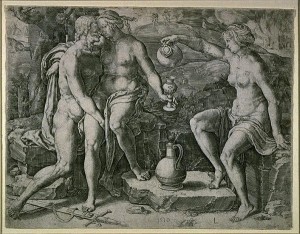
Lucas Van Leyden, Lot and His Daughters, 1530; Wikipedia.
- ART: REPRESENTATION OF BIBLICAL WOMEN
Part of The Jewish Women'south Archive 's Featured Collection on Feminism , Fine art: Representation of Biblical Women , is an extensive compilation of research comparing the portrayals of women in biblical stories among Christian and Jewish biblical texts. An alternate approach to the portrayals of women provided in the rest of this guide, Mati Meyer takes a cantankerous-religious look at how the social implications brought on by religious communities afflicted the fine art information technology produced. As Meyer points out, because "in early Christian and medieval art the epitome of biblical women served primarily to emphasize a typological meaning," I institute it essential that this essay be a part of this research guide as art reflects social club just as much every bit society reflects its art.
Gender Neutrality in Art

Géricault, Raft of the Medusa, 1818; Wikipedia
- GÉRICAULT, OR THE Absence OF WOMEN
Linda Nochlin'south Géricault, or the Absenteeism of Women is an essay published in the Bound 1994 edition ofOctober, a journal at the forefront of contemporary arts critique and theory. As the title suggests, Géricault, or the Absence of Women looks at one artist in particular, Théodore Géricault, and the portrayal of femininity in his piece of work, or rather the lack thereof.
Although quite specific in content, I find this source to exist essential to this research guide as Nochlin's methodology in critiquing Géricault's work tin be used when looking at other artworks from the same art period.
Nochlin, 50. "Géricault, or the Absenteeism of Women ." October, Vol. 68,Spring, 1994, pp. 45-59.Accessed Dec 1, 2014. MIT Press.http://www.jstor.org.ezproxy.bu.edu/stable/10.2307/778696?origin=crossref
- DID MEN INVENT ART TO BECOME WOMEN? MUST WOMEN BECOME MEN TO Brand Swell Art?
Part five of Roger Denson'southward vii-function essay series, Did Men Invent Art to Go Women? Must Women Get Men to Brand Great Art? Although very biased in content, as to back up his argument, Denson provides examples of art pieces that portray women in a gender-neutral state. This source provides variety to this research guide equally it presents a new portrayal of women in fine art history — not that of a victim or a femme fatale (ever imposing the female gender), but rather lacking the things that make her a woman and not yet a man.
Denson, R. "Did Men Invent Art to Become Women? Must Women Become Men to Brand Great Art?" Huffington Mail service. January 20, 2012. Accessed November iii 0, 2014.http://world wide web.huffingtonpost.com/g-roger-denson/did-men-invent-art-to-bec_b_1218788.html
Gender Differences in Fine art
These sources, using examples of both genders in art history, give a dissimilar perspective on the way revisionist historians look at the representation of women. Past critiquing the way men are portrayed, a conclusion can be drawn by contrasting the portrayal of women.

Fine art History Webmasters Association
- OH WHAT A DIFFERENCE GENDER MAKES: GENDER IN THE VISUAL ARTS
Noted as an an illustrated lecture for a Bluffton Higher Forum, Oh What a Difference Gender Makes: Gender in the Visual Arts , is one of the most informal sources of information pertinent to this inquiry guide. Although Mary Ann Sullivan provides the reader with many examples to show her point, she does so in a quick manner, leaving the art to support her argument rather than the writing itself. The series includes essays on: Gender Definitions in Portraits , Depictions of Male person and Female Nudes , Depictions of Maternity and Fatherhood , Gendered Working Roles , and Critiques of Gender Roles .
I felt this was essential for sources and because information technology compares both genders, rather than merely one, despite the title,
Ann Sullivan, K. "Oh What a Difference Gender Makes: Gender in the Visual Arts." Bluffton.edu. 2002. Accessed on November 23, 2014.http://www.bluffton.edu/~sullivanm/forum/gender.html
- Xx CHROMOSOCIAL, PART 1: WOMEN'S HIDDEN HOMOSOCIAL Past
Roger Denson's XX Chromosocial, Role one: Women'southward Hidden Homosocial Past can exist summarized in ane sentence:
"It's through art history that we meet what contemporary art can simply advise: how art over fourth dimension promotes cultural codes, and equally part of its historicizing and status-raising functions–the very functions that make fine art bonny to the affluent and powerful–fine art normalizes and perpetuates the specific conventions for a society'southward arrangement of sex and gender relations and the objects accorded them by the requisites of the dominant homosocial order."
In this source, Roger Denson takes a look at homosocial social club in history, every bit portrayed past art. The writer takes examples from pre-celebrated, Renaissance and post-Renaissance art to show but how factual is the representation of gendered activities in art history. I've decided to include this source in this enquiry guide considering I experience Denson supports his arguments with heavy amounts of examples and provides a research paper on the representation of women in art with an angle that has non been reached by the other sources in this guide.
Denson, R. "XX Chromosocial, Role i: Women's Hidden Homosocial By." Huffington Mail service. March eight, 2011. Accessed Nov xxx, 2014.http://world wide web.huffingtonpost.com/g-roger-denson/xx-chromosocial-women-art_b_832867.html
Sexuality and Eroticism in Art

Ingres, La Grand Odalisque, 1814; Wikipedia
- SEXUALITY IN WESTERN Fine art
Edward Lucy-Smith'southward Sexuality in Western Fine art is a comprehensive expect at portrayals of sexuality in fine art. The book starts with pre-celebrated art and places a heavy focus on fine art of the Renaissance. He considers the traditions in order and the time the fine art was fabricated and compares them to symbols in the artwork.
Lucy-Smith, E. Sexuality in Western Art . Thames & Hudson Ltd, 1991.
- SEXUALITY: AN ILLUSTRATED HISTORY
Sexuality: An Illustrated History is a pictorial history of sexuality in Western art. The book covers art periods ranging from the Middles Ages to contemporary fine art. Sander Gilman'southward reason for starting his study in the Middle Ages is that he uses the early on roots of Christianity to trace myth-making about the sexual form through art, literature, beefcake, and medicine. In using Christianity as a guideline of sorts for Sexuality: An Illustrated History , Gilman provides evidence to show how cultures are self-divers and shaped by systematic concepts of beauty and ugliness, masculinity and femininity, wellness and sickness, and the sacred and the secular and how these concepts have remained prevalent for nearly two millennia.
Although this volume doesn't always apply fine art as visual testify, I believe it's utilise of Christian fine art, specifically, caters to a research newspaper on the representation of women in fine art pertinent to the Renaissance Period as information technology is the culmination of Christian fine art.
Related Sources
- THE Fine art HISTORY Annal
Although informal in format, The Fine art History Archive remains a fairly thorough resource of data on artworks, art periods, artists, critiques, art by country/culture, and art history.
The video below provides visual context of virtually of the nudes aforementioned in the previous sources:
I've included the video beneath as some of the aforementioned sources compare female nudes to male nudes, too providing visual context to the research guide:
Source: https://blogs.bu.edu/guidedhistory/historians-craft/katryna-santacruz/
0 Response to "What Are the Similarities Tghe Women in Art Had in Common"
Post a Comment